Opulent Finishes for Your Guest Bath: Luxury Materials on a Realistic Budget
Elevate a guest bathroom on a budget by pairing humidity-rated matte wall paint, PVD-plated brass or brushed nickel plumbing fixtures, large-format porcelain tile, and warm 2700K–3000K vanity sconces. Because a full midrange bath remodel averaged $26,138 and recouped 80.0% at resale in Zonda's 2025 Cost vs. Value Report, targeted finish swaps deliver luxury impact without full-gut construction.
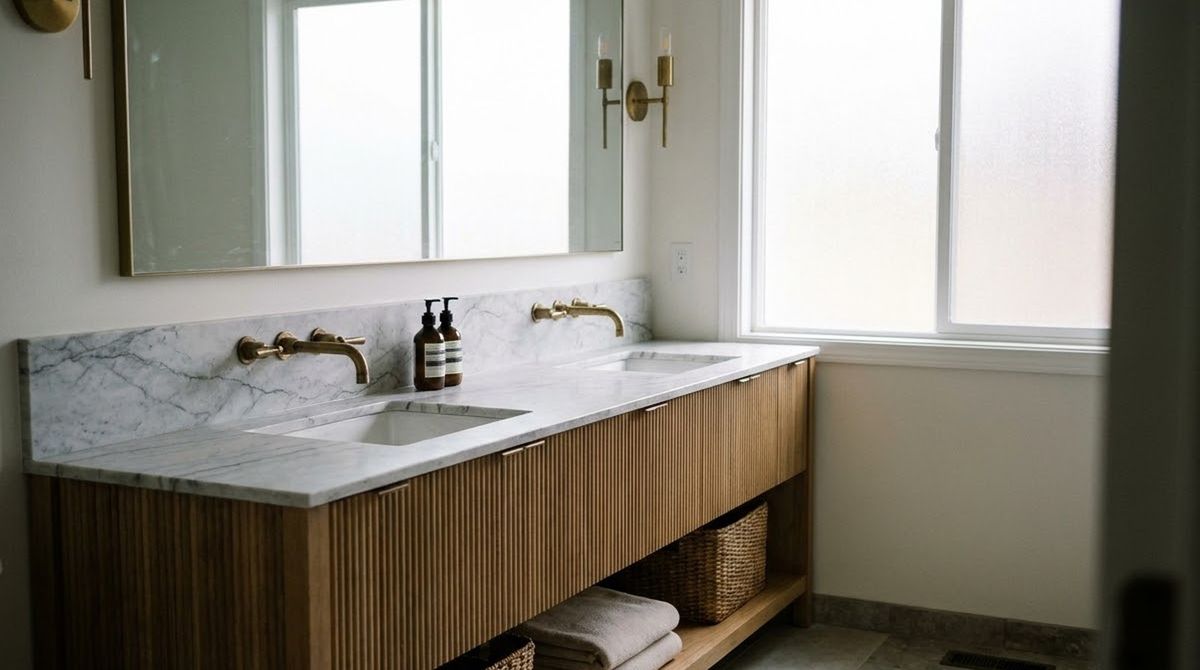
A guest bathroom feels opulent when every surface guests see and touch—walls, vanity top, faucet, mirror, lighting, and tile—shares a restrained material palette and clean detailing, even in a modest footprint. Because guest baths are smaller than primary suites, upgrading finishes goes much further per dollar than relocating plumbing or tearing out sound walls.
In Zonda’s 2025 Cost vs. Value Report published by the Journal of Light Construction, a full midrange bathroom remodel averaged $26,138 nationwide and recouped $20,915 (80.0%) at resale. That gap between full-remodel cost and resale return is why smart homeowners focus on high-impact finishes over existing layouts—saving structural work for failing subfloors or leaks, while investing in surfaces that create an immediate five-star impression.
What Makes a Guest Bath Feel Opulent
Opulence in a compact guest bathroom comes from tactile contrast and uncluttered symmetry rather than oversized square footage. Builder-grade guest baths look flat when everything is shiny beige tile, a frameless plate-glass mirror, and a harsh chrome bar light.
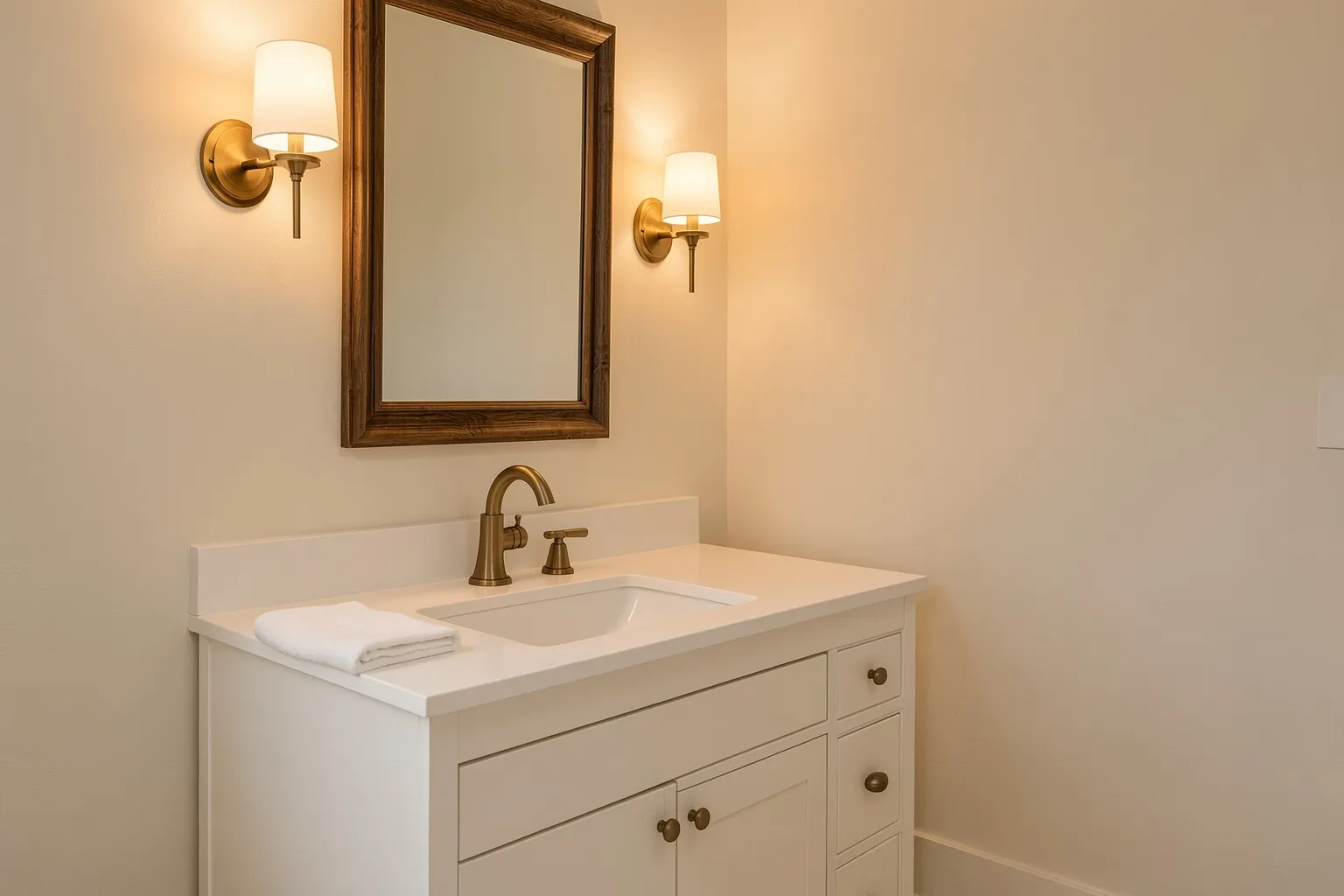
Four design choices create an immediate luxury shift:
- Low-glare wall finishes: Replacing shiny semi-gloss drywall with a velvety, humidity-rated matte paint softens shadows and makes wall colors look rich.
- Architectural metal warmth: Swapping builder chrome for PVD brushed brass, polished nickel, or matte black adds visual weight at the sink and towel bar.
- Eye-level vanity lighting: Moving light from a single overhead strip down to flanking sconces (or a backlit framed mirror) flatters faces and eliminates harsh under-eye shadows.
- Natural or stone-look textures: Pairing a fluted wood or painted vanity with veined porcelain or a stone remnant top introduces organic pattern without visual noise.
Wall Finishes: Humidity-Rated Matte Paint vs. Tile and Wallpaper
Walls account for the largest visual area in a guest bath, and choosing the right moisture-tolerant finish prevents peeling while elevating color depth.
Humidity-Rated Matte Bath Paint
Historically, painters defaulted to semi-gloss in bathrooms because standard flat latex absorbed steam and water spots. However, Sherwin-Williams’ sheen guidance explains that high-sheen paints spotlight every drywall tape seam and wall flaw under vanity lighting. Today, specialty coatings such as Benjamin Moore Aura Bath & Spa deliver a genuine matte finish engineered for high-humidity rooms with mold- and mildew-resistant protection. That lets you use rich warm neutrals, muted greens, or crisp off-whites without plastic-looking glare.
Half-Height Wainscoting or Tile
In a powder room or guest bath with a shower, running simple painted beadboard, vertical tongue-and-groove, or ceramic subway tile up the lower 36 to 42 inches protects drywall from splashes and adds architectural molding. Use a satin or semi-gloss urethane trim enamel on wood wainscoting so it wipes clean easily.
Plumbing Fixture Finishes and WaterSense Performance
The sink faucet, showerhead, and drain trim are the jewelry of a guest bath—and the parts guests operate directly. Investing in durable plating and tested flow performance pays off in both feel and longevity.
Why PVD Finishes Outlast Standard Plating
Painted or thin-lacquered faucet finishes can spot or flake with daily cleaning. Physical Vapor Deposition (PVD) is a coating process used on metal fixtures. As Kohler’s Tone faucet brochure states, its PVD finishes, such as Vibrant Brushed Nickel and Vibrant Brushed Moderne Brass, are designed to withstand everyday use and resist scratches, corrosion, and tarnishing. Stick to mild soap and a soft microfiber cloth; abrasive cleaners can dull any finish.
Balancing Efficiency with Guest Comfort
Modern water-efficient fixtures no longer feel weak. Per the U.S. EPA WaterSense bathroom faucet standard, WaterSense-labeled lavatory faucets and aerators cap flow at 1.5 gallons per minute (gpm)—at least 30% below the standard 2.2 gpm flow—while independent certification verifies stream performance. Likewise, EPA WaterSense-labeled showerheads use no more than 2.0 gpm compared to the standard 2.5 gpm baseline, saving water and hot-water energy without sacrificing spray coverage.
Vanity Tops, Sinks, and Cabinetry Finishes
A guest bathroom vanity is small enough (often 24 to 48 inches wide) that upgrading the countertop and cabinet finish costs far less than in a kitchen, making stone remnants and furniture-style vanities accessible.
- Quartz and Natural Stone Remnants: Local stone yards routinely sell leftover pieces from kitchen slabs that fit a 30- or 36-inch vanity top. Engineered quartz is non-porous and never needs sealing; if you choose natural marble, follow Natural Stone Institute care guidance: clean with a neutral stone cleaner or mild dish detergent, and keep acidic products such as lemon or vinegar off it, since they may dull or etch calcareous stone. Sealing makes stone more stain resistant, not stain proof.
- Cultured Marble and Porcelain Integrated Tops: For tight budgets, a crisp white rectangular integrated porcelain or matte cultured-marble top eliminates rim seams and wipes dry in seconds.
- Vanity Cabinet Refinishing: If your existing vanity box is sturdy, painting it in a deep charcoal, warm taupe, or sage urethane enamel and adding heavy brass or black pulls transforms it into a custom piece. See our kitchen finishes guide for step-by-step enamel and sheen pairing advice.
Bathroom Tile, Grout, and Slip-Safety Standards
Tile sets the tone for a guest bath’s floor and shower enclosure, and safety standards matter just as much as veining and pattern.
Slip Resistance on Wet Floors
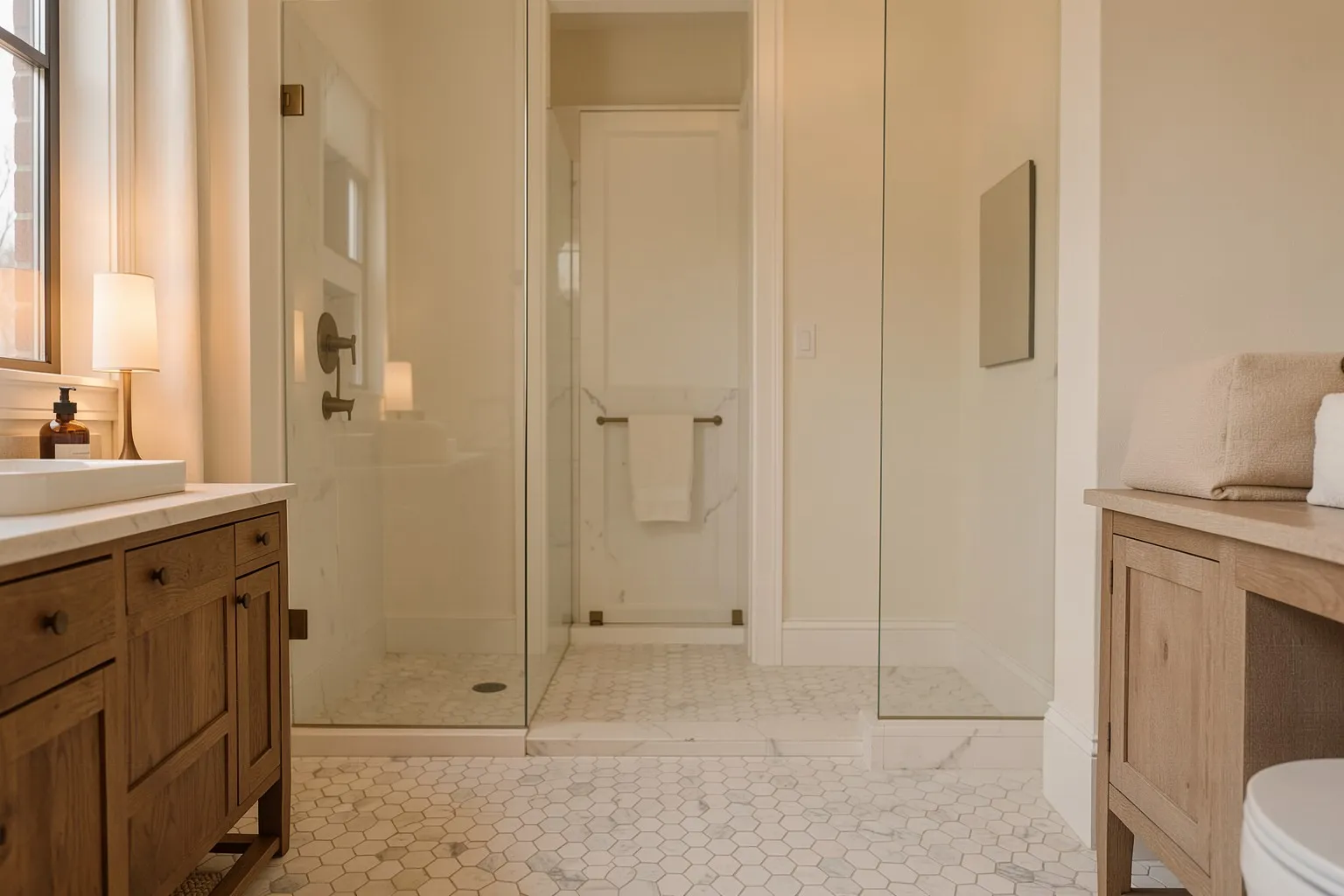
Glossy polished marble looks striking on shower walls, but on a bathroom floor it becomes hazardous as soon as water drips from a tub or towel. When selecting bathroom floor tile, check the manufacturer’s wet Dynamic Coefficient of Friction (DCOF) rating. The Ceramic Tile Education Foundation’s Scott Carothers explains that the tile standard now requires a minimum wet DCOF AcuTest value of 0.42 for ceramic tile in level interior spaces expected to be walked on when wet. Many matte or honed porcelain tiles are tested to this threshold while mimicking Calacatta marble or limestone, so confirm the number on each product’s spec sheet.
Grout Color and Scale
Large-format porcelain tiles (such as 12x24 inches) reduce the number of grout lines in a small bathroom, making the floor feel calmer and easier to mop. Match your grout closely to the tile body—and use stain-resistant, pre-sealed, or epoxy grout in shower zones—so lines do not darken unevenly.
Lighting, Mirrors, and Electrical Safety in Wet Zones
Flattering lighting and a framed mirror turn a utilitarian bathroom into a welcoming retreat, provided every fixture is properly rated for moisture and electrical code.
Color Temperature and Fixture Placement
Under ENERGY STAR solid-state lighting criteria, warm residential LEDs are certified at 2700K, 3000K, and 3500K. For a guest bathroom, 2700K or 3000K bulbs with 90+ CRI render skin tones naturally without harsh clinical glare. Mount sconces on either side of a framed mirror at roughly eye level when wall space allows, or choose an LED-backlit mirror paired with a warm overhead flush mount. For more fixture sizing and layering tips, explore our statement lighting guide.
Damp Ratings and GFCI Protection
Always check the listing label on bathroom lighting: the National Electrical Code requires luminaires installed in damp or wet locations to be marked “Suitable for Damp Locations” or “Suitable for Wet Locations” as appropriate, so use a wet-location-rated fixture for any light in or directly above the shower or tub and follow the manufacturer’s instructions.
Electrical safety rule: Before replacing any vanity light or switch, turn off the breaker, verify power is off with a non-contact voltage tester and at the device terminals, and follow the fixture manufacturer’s instructions and local electrical code. Under NEC Section 210.8(A), 125V–250V receptacles in bathrooms and within 6 feet of the outside edge of a bathtub or shower stall require GFCI protection. Hire a licensed electrician for any new wiring, GFCI upgrades, or exhaust fan additions.
Recreating Luxury Hotel Bathroom Features Under $500
You do not need a full tile or vanity overhaul to give guests a boutique-hotel experience. Targeted swaps—such as a WaterSense multi-function showerhead, a curved shower rod, plush cotton towels, a framed mirror, and warm vanity bulbs—can transform the room for under $500. Read our dedicated guide on luxury hotel bathroom features you can recreate at home for under $500 for a complete item-by-item breakdown.

Powder Room vs. Full Guest Bath: Adjusting Your Finish Choices
A half-bath powder room has no shower steam, which opens up bolder wall and surface options than a full guest bathroom with a tub or walk-in shower. Matching your finish durability to the room’s moisture load prevents premature peeling or warping.
- Half-bath powder room: Without daily shower humidity, you can safely use textured grasscloth-look vinyl wallpaper, saturated dark matte paint, or a dramatic honed natural marble remnant top without constant steam exposure. Because powder rooms are small, a rich wall color paired with a PVD brushed-brass sconce pair feels jewel-box intentional.
- Full guest bath with shower: Prioritize moisture-resistant coatings, sealed porcelain or quartz surfaces, and corrosion-resistant PVD fixtures. Keep wood cabinetry elevated on legs or well-sealed along the toe-kick so damp bath mats never wick moisture into particleboard.
Mirror, Shower Glass, and Hardware Finishing Details
Secondary architectural surfaces—mirrors, shower doors, and cabinet pulls—either tie a guest bath together or betray builder-grade shortcuts.
Upgrading the Vanity Mirror
Replacing a wide, clip-mounted sheet mirror with a framed mirror immediately introduces structure. Choose a metal-framed round or arched mirror that echoes your faucet finish, or hang a warm wood-framed mirror to soften cool marble-look tile. Leave some breathing room between the faucet spout and the bottom edge of the mirror frame so water splashes do not collect on the frame.
Shower Enclosure Glass and Trim
If your guest bath has a dated aluminum-framed sliding tub door, removing the tracks and installing a crisp curved shower rod with an extra-long waffle curtain often looks cleaner than cheap replacement tracks. When your budget covers glass, clear tempered glass with minimal brushed-brass or matte-black clamps keeps sightlines open so your tile work remains the focal point.
Cabinet Pulls and Towel Hardware
Match your vanity pulls, towel ring, toilet paper holder, and robe hooks in one consistent metal tone. Mounting a sturdy double robe hook near the shower entry—anchored into a stud or rated hollow-wall anchor—gives guests a convenient spot for a towel or robe without crowding a single towel bar.
Protecting Bathroom Finishes: Ventilation, VOCs, and Care
Even the highest-grade finishes fail early in a poorly ventilated bathroom. Controlling humidity and cleaning gently preserves your investment for years.
- Run the exhaust fan consistently: Moisture lingering on walls and ceilings accelerates mildew growth and swells wood trim. Run a quiet exhaust fan during every shower and afterward; the Home Ventilating Institute recommends leaving the fan on for 20 minutes after use of the bathroom. A countdown timer wall switch makes this effortless for houseguests.
- Ventilate while painting: Compact bathrooms trap paint fumes quickly. Because U.S. EPA indoor air quality guidance notes that concentrations of many VOCs are consistently higher indoors, up to ten times higher, than outdoors, choose low- or zero-VOC bathroom coatings, run the exhaust fan, and open a window while painting and curing.
- Clean finishes gently: Skip abrasive scouring powders, bleach sprays, or acidic cleaners on PVD brass, matte black fixtures, and natural stone. Wipe faucets dry with a soft microfiber cloth and use a neutral stone cleaner on natural stone.
- Inspect silicone seams annually: Check the caulk line where the tub meets tile and where the vanity backsplash meets drywall. Re-caulking a hairline crack promptly helps prevent hidden water damage behind drywall.
Guest Bath Budget Tiers: Where to Spend vs. Save
Allocating your guest bath budget by visual impact ensures you do not overspend on hidden changes while visible surfaces stay dated.
- Cosmetic Finish Tier (Paint, Lighting, Mirror, Hardware): Keep the existing vanity, tub, and floor tile intact. Spend on humidity-rated matte paint, warm 2700K–3000K sconces or bulbs, a framed mirror, and coordinated PVD towel hardware.
- Fixture & Vanity Top Tier: Add a WaterSense 1.5 gpm bathroom faucet, a 2.0 gpm WaterSense showerhead, and a quartz or cultured-marble vanity top replacement over your existing cabinet box—or swap in a pre-assembled furniture-style vanity using existing plumbing rough-ins.
- Full Surface Reset: When floor tile is cracked or subflooring is soft, replace flooring with slip-rated matte porcelain (wet DCOF >= 0.42 per the manufacturer’s spec sheet) and hire a licensed plumber and electrician for any valve, drain, or GFCI circuit upgrades.
To see how much of a bathroom budget tends to come back at resale, try the splurge vs save planner, and read which splurge-worthy investments add value and which to skip before you spend.
Common Guest Bath Finish Mistakes to Avoid
Avoid these five missteps that undermine otherwise thoughtful bathroom updates:
- Using standard flat wall paint in a steamy bath: Regular flat latex absorbs moisture and shows water streaks; always specify a humidity-rated matte bath formula.
- Choosing polished floor tile: Sleek glossy stone or polished porcelain looks luxurious on walls, but creates a serious slip hazard when wet on floors.
- Hanging vanity lighting too high: A single bar light mounted near the ceiling casts harsh downward shadows; eye-level flanking sconces or a backlit mirror flatter faces far better.
- Mixing too many metal finishes: Combining chrome shower trim, brushed-nickel hinges, and brass vanity pulls looks accidental rather than curated. Stick to one primary finish or two clearly repeated finishes.
- Overcrowding the vanity counter: Leaving extra toiletries, plastic dispensers, and tangled cords on a small guest vanity hides your new countertop; keep only hand soap, lotion, and a small tray or bud vase on display.
Coordinating Your Guest Bath With the Rest of Your Home
A guest bath feels most intentional when its finishes echo the rest of your home rather than reading like an unrelated showroom vignette. Carrying the same cabinet enamel tone, PVD metal finish, or warm 2700K–3000K lighting temperature from your budget-friendly room makeover or affordable kitchen upgrades creates seamless flow from room to room.
Before ordering full quantities of tile, paint, or hardware, gather physical samples—a tile offcut, a painted foam-core board, and your faucet finish—and inspect them inside the guest bathroom at both morning daylight and evening vanity light. Artificial bathroom lighting can shift cool gray marble into blue or turn warm beige paint muddy, so testing in the actual room ensures every surface looks cohesive together. Once installed, a simple routine of running the exhaust fan, wiping PVD fixtures dry with microfiber, and caring for natural stone as directed keeps the guest bath looking freshly finished for years.
Quick Guest Bath Finish Checklist Before You Buy
Confirm these five practical details before placing your order so nothing arrives out of proportion or unrated for a wet room:
- Check vanity depth and door swing: Verify that a new vanity or framed mirror leaves clear room for the entry door and shower door to open without colliding.
- Verify fixture location ratings: Confirm vanity sconces are marked for damp or wet locations and any light in or above the shower is wet-rated.
- Confirm DCOF on floor tile: Check that bathroom floor porcelain carries a wet DCOF of 0.42 or higher (see the Tile Letter explainer).
- Match drain and overflow trim: When swapping a sink faucet, order a matching pop-up drain and tub overflow plate in the same PVD finish.
- Test shutoff valves: Turn angle stops gently before disconnecting supply lines; replace corroded multi-turn valves with quarter-turn ball valves via a licensed plumber if they stick.
| Finish Category | Budget-Luxury Pick | Key Performance Advantage | Care / Safety Note |
|---|---|---|---|
| Wall Paint | Humidity-rated matte bath paint | Velvety depth without shiny glare; mildew-resistant | Run exhaust fan during and after showers |
| Plumbing Hardware | PVD brushed brass or nickel | Resists scratches, corrosion, and tarnishing | Look for WaterSense 1.5 gpm faucet / 2.0 gpm showerhead |
| Vanity Top | Cultured marble or quartz remnant | Non-porous, wipe-clean surface without sealing | Avoid abrasive pads; use mild soap |
| Bathroom Floor Tile | Matte porcelain (DCOF >= 0.42) | Mimics marble or limestone with low water absorption | Verify the wet DCOF rating before buying |
Prioritize PVD plumbing fixtures, humidity-rated matte paint, and a remnant stone or cultured marble vanity top; leave floor tile intact if existing tile is sound and slip-safe.
All Bathroom Luxury Budget guides
- Luxury Hotel Bathroom Features You Can Recreate at Home for Under $500
Recreate five-star hotel bathroom comfort for under $500 with WaterSense showerheads, curved rods, plush linens, and warm vanity lighting.
Frequently asked questions
What finishes make a guest bathroom look expensive on a budget?
PVD brushed brass or polished nickel faucets, a framed or backlit mirror, warm 2700K–3000K wall sconces, and a velvety matte bath paint immediately elevate a guest bath. Because guest bathrooms are compact, swapping just the faucet, cabinet pulls, light fixture, and towel hardware creates a cohesive designer look without moving plumbing or tearing out tile.
Can you use matte paint in a bathroom with a shower?
Yes, provided you choose a paint specifically engineered for high-humidity rooms rather than standard flat wall latex. Products such as Benjamin Moore Aura Bath & Spa deliver a low-luster matte look with a mold- and mildew-resistant coating. Always pair any bathroom paint with a working exhaust fan and allow the coating to cure fully before heavy steam exposure.
How much does a full bathroom remodel cost compared to a finish refresh?
In Zonda's 2025 Cost vs. Value Report, a full midrange bathroom remodel averaged $26,138 nationwide and returned $20,915 (80.0%) at resale. By contrast, keeping your existing tub, toilet, and layout while upgrading only paint, lighting, mirror, faucet, and hardware achieves a dramatic visual reset for a fraction of a full renovation's cost.
What is the best slip-resistant tile finish for a bathroom floor?
Choose a matte or textured porcelain tile with a wet Dynamic Coefficient of Friction (DCOF), tested to ANSI A326.3, of 0.42 or higher for level bathroom floors. Polished marble or glossy ceramic looks sleek on walls, but becomes slick when wet; matte porcelain replicates natural stone veining while providing safer traction and minimal water absorption.
Are WaterSense bathroom faucets and showerheads good enough for a luxury guest bath?
Yes. EPA WaterSense-labeled bathroom faucets flow at up to 1.5 gpm and showerheads at up to 2.0 gpm, and both undergo independent performance testing to ensure strong spray coverage and rinsing power. Guests notice steady pressure and temperature stability, not wasted gallons.
Do I need GFCI outlets near a guest bathroom vanity?
Yes. Under National Electrical Code Section 210.8(A), all 125V–250V receptacles in bathrooms—and within 6 feet of the outside edge of a bathtub or shower stall—require Ground-Fault Circuit Interrupter (GFCI) protection. Have a licensed electrician install or test GFCI protection if your guest bath lacks it.
Source notes
- 2025 Cost vs. Value Report: National Averages — Journal of Light Construction (jlconline.com)
- WaterSense Bathroom Faucets — U.S. EPA (epa.gov)
- WaterSense Showerheads — U.S. EPA (epa.gov)
- Aura Bath & Spa Matte Acrylic Interior Paint Brochure — Benjamin Moore (media.benjaminmoore.com)
- Kohler Tone Bathroom Faucet Brochure (PVD Finishes) (resources.kohler.com)
- Tile Letter — DCOF Rating Requirements for Interior and Exterior Tile (tileletter.com)
- Care & Cleaning of Natural Stone — Natural Stone Institute (naturalstoneinstitute.org)
- Bathroom Ventilation — Home Ventilating Institute (hvi.org)
- Volatile Organic Compounds' Impact on Indoor Air Quality — U.S. EPA (epa.gov)
- NFPA Standards Council Minutes — NEC Section 210.8(A) GFCI Protection (content.nfpa.org)
- ENERGY STAR Solid-State Lighting (SSL) Criteria for Manufacturers (energystar.gov)
- Differences Between Paint Sheens — Sherwin-Williams (sherwin-williams.com)
Related guides
- Luxury Hotel Bathroom Features You Can Recreate at Home for Under $500
Recreate five-star hotel bathroom comfort for under $500 with WaterSense showerheads, curved rods, plush linens, and warm vanity lighting.